Key Takeaways
- Modular office containers enable rapid, flexible workspace deployment and customization.
- Advanced robotics, including humanoid robots and collaborative robots (cobots), drives operational efficiency and safety.
- Omnidirectional mobility systems increase adaptability in tight industrial spaces.
- Digital maintenance platforms reduce downtime and enhance equipment performance.
Modern industrial environments demand versatility, productivity, and efficiency. Companies across sectors are turning to innovative mobility solutions to address evolving workspace needs, minimize downtime, and remain competitive. The integrated use of automation, modular design, and digital workflows is redefining how workspaces are constructed and utilized. Among these solutions, heavy duty caster wheels play a foundational role, allowing for the seamless movement of equipment, office containers, and machinery within even the busiest facilities.
Integrating advanced mobility into workspaces isn’t just a logistical improvement—it’s a strategic move to support employee safety, productivity, and overall operational success. Whether you’re accommodating rapid growth, transitioning to flexible operations, or streamlining plant layouts, industrial mobility solutions are critical enablers. They offer the agility to respond to new challenges without the need for disruptive and costly infrastructure changes, ensuring continuity and efficiency as demands shift.
Modular Office Containers: Flexible Workspaces
Modular office containers are revolutionizing the way organizations approach workspace design across various industries, including construction, education, and healthcare. Unlike traditional structures, these fully self-contained units are built off-site and delivered ready for immediate use, significantly reducing installation time and overall project costs. Their inherent adaptability enables companies to quickly reconfigure layouts as needs evolve, whether to accommodate team expansion, create private meeting spaces, or adjust workflow patterns.
This flexibility is further enhanced through the use of heavy-duty caster wheels, which make relocating entire units remarkably easy. Offices, storage areas, and meeting pods can be repositioned within the same complex with minimal effort, supporting efficient scaling and allowing organizations to respond swiftly to changes such as social distancing requirements or operational surges. With their mobility, durability, and potential for modern design, modular office containers offer a practical and forward-thinking solution for today’s dynamic workplace environments.
Advanced Robotics and Automation
Robotics and automation are transforming the management of repetitive and labor-intensive industrial tasks. Companies like Schaeffler have pioneered AI-integrated humanoid robots capable of advanced assembly, transport, and inspection duties traditionally assigned to human teams. These robots dramatically improve precision, reduce error rates, and operate safely around people, contributing to significant productivity gains in manufacturing and logistics settings.
Robotics adoption is no longer confined to large global enterprises; scalable solutions now exist for companies of all sizes. The integration of these systems often begins with pilot projects, where collaborative robots, or cobots, are tested on the production floor, enabling organizations to evaluate performance and safety before expanding their usage.
Collaborative Robots (Cobots)
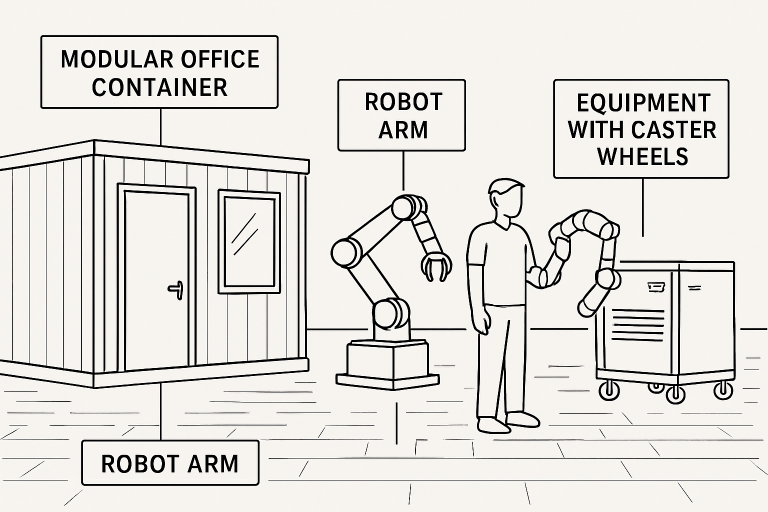
Collaborative robots are designed to work seamlessly with human operators, enhancing both safety and productivity. At the 2024 Hannover Messe, Delta introduced advanced cobots specifically designed to enhance smart factory automation. These systems feature intuitive programming interfaces, enabling operators to quickly adapt them to various tasks without requiring deep technical expertise.
By assigning repetitive or ergonomically challenging duties to cobots, companies boost productivity and free up employees to focus on higher-value work, such as process optimization or quality control. Cobots also support safer work environments, as they are built with built-in sensors and collaborative features that prevent accidental harm during operation.
Omnidirectional Mobility Systems
Omnidirectional mobility systems represent a significant leap forward in robotic navigation, particularly in highly constrained or dynamic environments. Unlike traditional wheeled robots, those equipped with Omni Differential Drive (ODD) can simultaneously move, turn, and reconfigure their paths, navigating tightly packed work areas with ease. Research published on this topic demonstrates how these systems significantly improve adaptability and reduce movement bottlenecks in industrial environments.
The integration of such platforms enables facilities to maximize utilization of available floor space and adjust quickly to changing production or storage requirements. As industrial layouts become increasingly complex, the need for truly adaptive mobility solutions will continue to grow.
Digital Maintenance Platforms
Digital maintenance platforms are redefining how companies manage equipment lifecycles. Centralizing equipment monitoring, preventive maintenance scheduling, and repair tracking ensures higher reliability and reduces costly unplanned downtime. Solutions like Mobility Work aggregate real-time data, presenting actionable insights that empower maintenance teams to make data-driven decisions for continuous improvement.
The transition to cloud-based maintenance management supports instant visibility over dispersed assets, even across multiple branches or sites. By automating routine maintenance reminders and capturing historical data trends, companies can extend the usable life of critical machines and avoid the production losses associated with breakdowns.
Implementing Mobility Solutions: A Step-by-Step Guide
- Assess Operational Needs: Conduct a thorough review of workflows and identify where mobility enhancements will yield the most value.
- Research Available Technologies:Analyze current solutions, including modular office containers, robotics, and digital tools, to determine which best match your requirements.
- Develop an Integration Plan: Align new mobility solutions with existing processes and infrastructure to ensure minimal disruption.
- Train Staff: Offer comprehensive employee training to ensure effective adoption and safety with new technologies.
- Monitor and Optimize: Regularly review key performance metrics and refine strategies to maximize ROI over time.
Conclusion
The adoption of innovative industrial mobility solutions is rapidly becoming standard for businesses seeking operational excellence and resilience. By leveraging flexible, modular offices, advanced robotics, omnidirectional transport, and digitized maintenance, leaders can foster efficient and adaptable ecosystems capable of thriving in today’s ever-changing markets.